
This
Month on the Emmbrook
What to look for if you are out and about in
NOVEMBER
General
Autumn is well and truly with us and it's a fantastic time to get out and about and experience the "season of change". Hard frosts may have started and early mornings are often misty, as the dew from the ground condenses during the night. This month sees the last of the leaves on the deciduous trees falling to the ground.
Birds

The Robin, so often associated with the festive season, can be particularly tame during the colder months.
Robins are one of the few birds that can be heard singing during winter, as both the males and females
maintain territories for feeding during this period, which may be their breeding territories later.
Around Christmas-time Robins begin exploring other Robins' territories looking for a mate. They then pair up by mid-January and females stop singing.
Flocks of Fieldfare arrive in Britain to spend the winter months as our climate is warmer than northern and eastern Europe where they spend the summer.
These thrushes have grey heads and can appear quite ‘upright’ on the ground. Look out for large flocks feeding on grassland, including playing fields, and in hedgerows nearby.
Listen out for a high-pitched ‘tseep, tseep’ at night. It’s the sound of Redwings flying high overhead as they arrive in Britain to spend the winter here.
They have a distinctive creamy white eye stripe and orangey/red patch under their wing.
All so look out for large, noisy flocks of busy long-tailed tits flitting around the trees as they search for insects to eat. The flocks are often joined by blue tits and great tits for safety in numbers from predators such as sparrowhawks looking for a meal.
Long-tailed tits are easy to identify from their ‘si-si-si’ calls.
It’s the sound of Redwings flying high overhead as they arrive in Britain to spend the winter here.
They have a distinctive creamy white eye stripe and orangey/red patch under their wing.
All so look out for large, noisy flocks of busy long-tailed tits flitting around the trees as they search for insects to eat. The flocks are often joined by blue tits and great tits for safety in numbers from predators such as sparrowhawks looking for a meal.
Long-tailed tits are easy to identify from their ‘si-si-si’ calls.
Insects
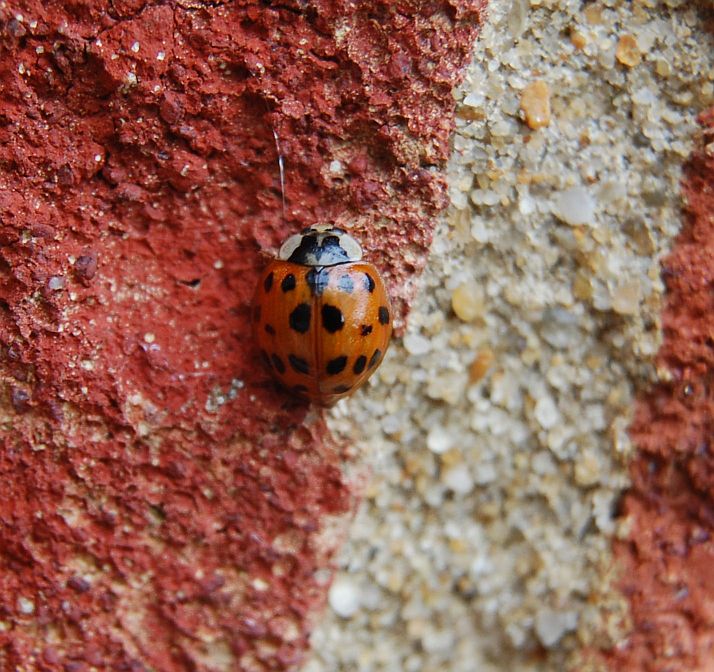
Many insects overwinter in forms other than the adult, such as the pupa (moths and some butterflies) or the larva (Caddis flies). Some remain as adults such as Wasps. Adult Ladybirds and Peacock butterflies seek out warm nooks in sheds and attics to hide. Here the air is moist but not so cold.
Keep an eye out for Harlequin Ladybirds. Harmonia axyridis It takes its common name from the fact that over 100 different colour patterns have been recorded. Some specimens are reddish-orange with black dots, while others are black with red patches. This of course makes it difficult to identify. Harlequin Ladybirds spend the winter in buildings – often in large numbers.
Other Wildlife
Hedgehogs are hibernating at this time of year but urban Foxes can still be seen and heard. At this time Bats enter a state of torpor in their hibernacula. This is not a full hibernation as Bats will emerge on warm days, but is a state of reduced metabolism and body temperature. In this state less energy is required.
Toads are now in hibernation, finding logs or stones to hide beneath until Spring arrives once more. Frogs are also hibernating at the bottom of ponds, or some other sheltered place, ready to emerge again in the following January.
Plants & Trees
The Oak waits until November to put on its best Autumn show of colour, having only made a tentative start in October. There are two main types of British Oak; the Sessile and the Pedunculate Oak. In the former, the acorns are borne in cups, with almost no stalk attaching them to the stem. In the later, however, the acorn cups are attached with shared long stalks. On chilly mornings, plants and seed heads such as teasel can take on artistic frosty forms. It’s worth keeping seed heads standing in your garden through the winter, not only for their attractiveness for us on cold winter mornings, but for birds looking for food and insects that hide inside through the winter.